MICROSTRUCTURES LAB
In a world of counterfeit products, authenticity needs proof. Our microstructure labels carry a unique signature that cannot be copied, and a scanner verifies it in seconds.
About us
Microstructures Lab OÜ is an engineering and technology company founded in 2017, specialising in the development of advanced products and solutions based on microstructures.
Our team combines extensive research and engineering experience to develop technologies that protect products against counterfeiting and prevent fraud in commercial transactions. Drawing on fundamental research in physics and chemistry, and supported by advanced mathematical algorithms, we create highly secure authentication solutions. Our security labels feature unique physical properties that cannot be reproduced using any currently known technology.
Building on our expertise in microstructure engineering, our research team is also developing innovative microfluidic technologies. Our work focuses on cascading fluid dynamics and selective protein fractionation in microfluidic systems. We design and test microfluidic chip architectures, investigate multiphase flow behaviour, and study droplet generation processes. These developments provide the technological foundation for portable diagnostic solutions, including Lab-on-a-Chip devices and rapid medical tests.
Technology
Fighting counterfeit products is a big issue for every big brand, and for seemingly every protection technology that initially looked very reliable (e.g. holograms) there is soon a “remedy” invented by counterfeiters. We strongly believe that we have created a technology which cannot be hacked or worked around at the current level of technology, nor with technologies that will be available in the near future.
“Very sophisticated technology is required to make the marks, which is only available in a few countries in the world. Even with this technology, it is not possible to duplicate a mark, as each mark is produced with a random and unique signature. The probability of producing two identical marks is approximately 1 in a quadrillion quadrillions. The marks are virtually impossible, if not impossible, to replicate by any other means.” From the final due diligence report (SRI Project 11561) on our protection technology, prepared by Stanford Research Institute (SRI International, 333 Ravenswood Avenue, Menlo Park, California).
Micro-dots instead of codes
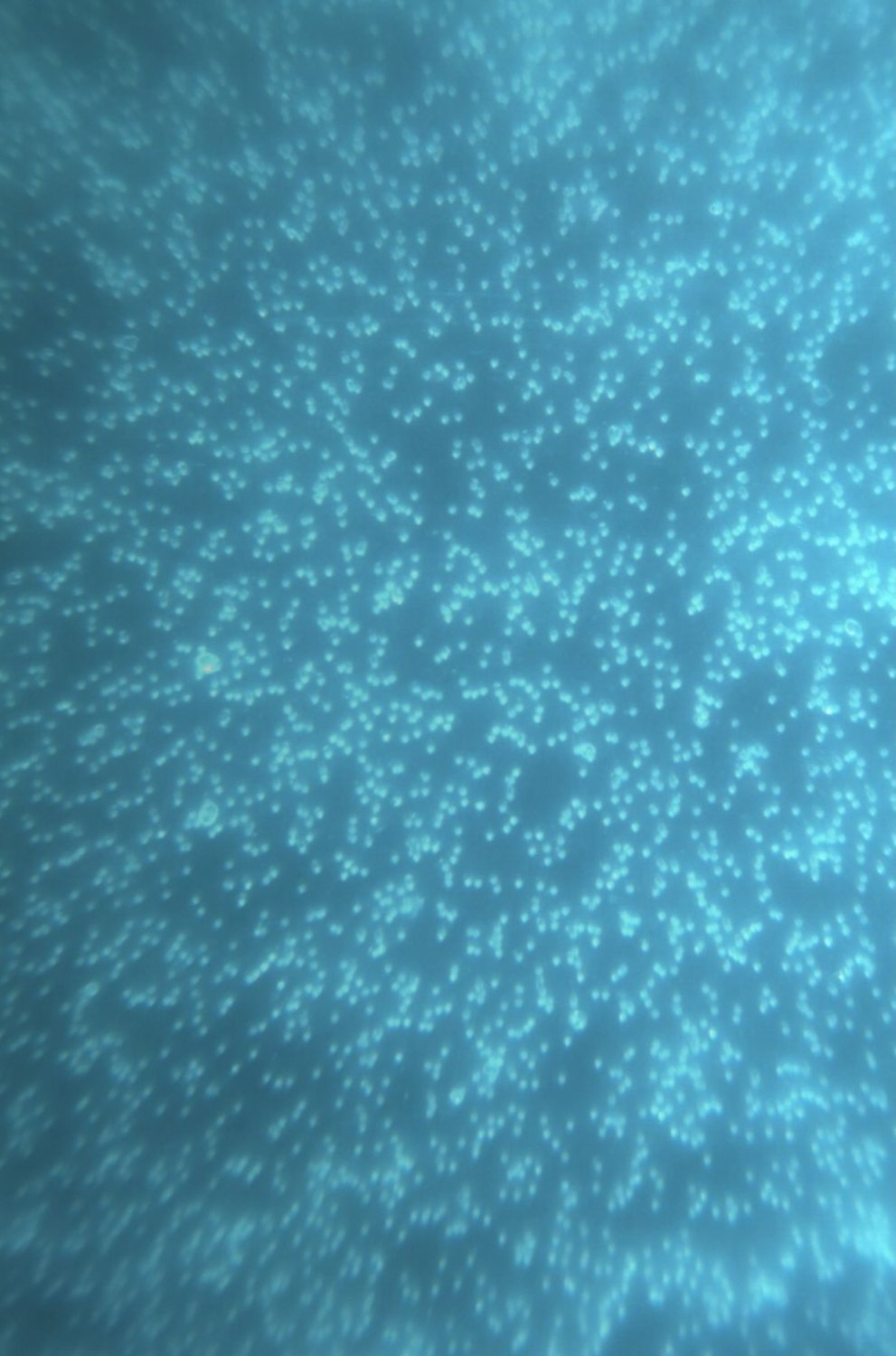
Our solutions are based on microstructures: myriads of micro-dots invisible to the naked eye but which are (with proper optical recognition and mathematical analysis) easily and automatically identifiable.
A very small piece (1×1 mm) of the label is enough to reliably authenticate it.
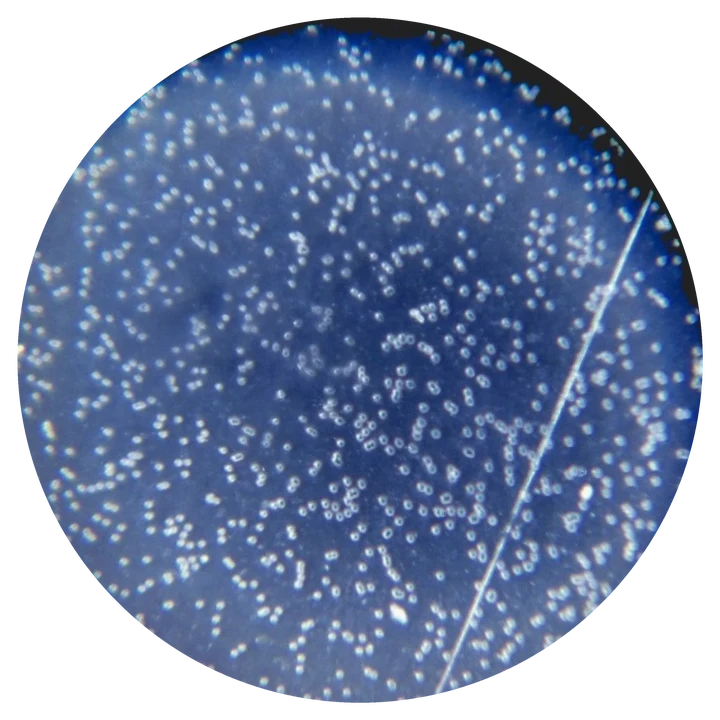
Shot on a phone with an additional backlit lens
Verified in seconds
The identification process is fully automated and takes a few seconds. To read the data, a compact scanner (about the size of a mobile phone) is used, which is held against the product's packaging or label.
Depending on the task, identification can be done offline or by matching the security labels read by the sensor against a cloud database. The solution can be based solely on our security labels or combined with bar/
Key benefits
Impossible to copy
No modern replication or reproduction technologies, be it optical scanning/
Objective checks
Authenticity checks are carried out by automated devices and are therefore repeatable and unbiased, unlike experts' opinions, and do not depend on an expert's qualification.
Easy to adopt
Our technology does not require expensive or untraditional materials to produce and attach the security labels to consumer products. The labels blend nicely with whatever design is used on product tags and labels, and with existing mass production technologies.
Cloud database
There is also a cloud database as a part of our solution that can be flexibly configured to be accessible by manufacturers, distributors and certified merchants across the globe. The database can be extended by any value-added services our customers are interested in (like customer data, supply-chain tracking data, etc.), by the customers themselves or by our lab.